Air Quality Monitor | Qingping Lite Air | App connection
5-in-1 indoor air quality monitor with Apple HomeKit support
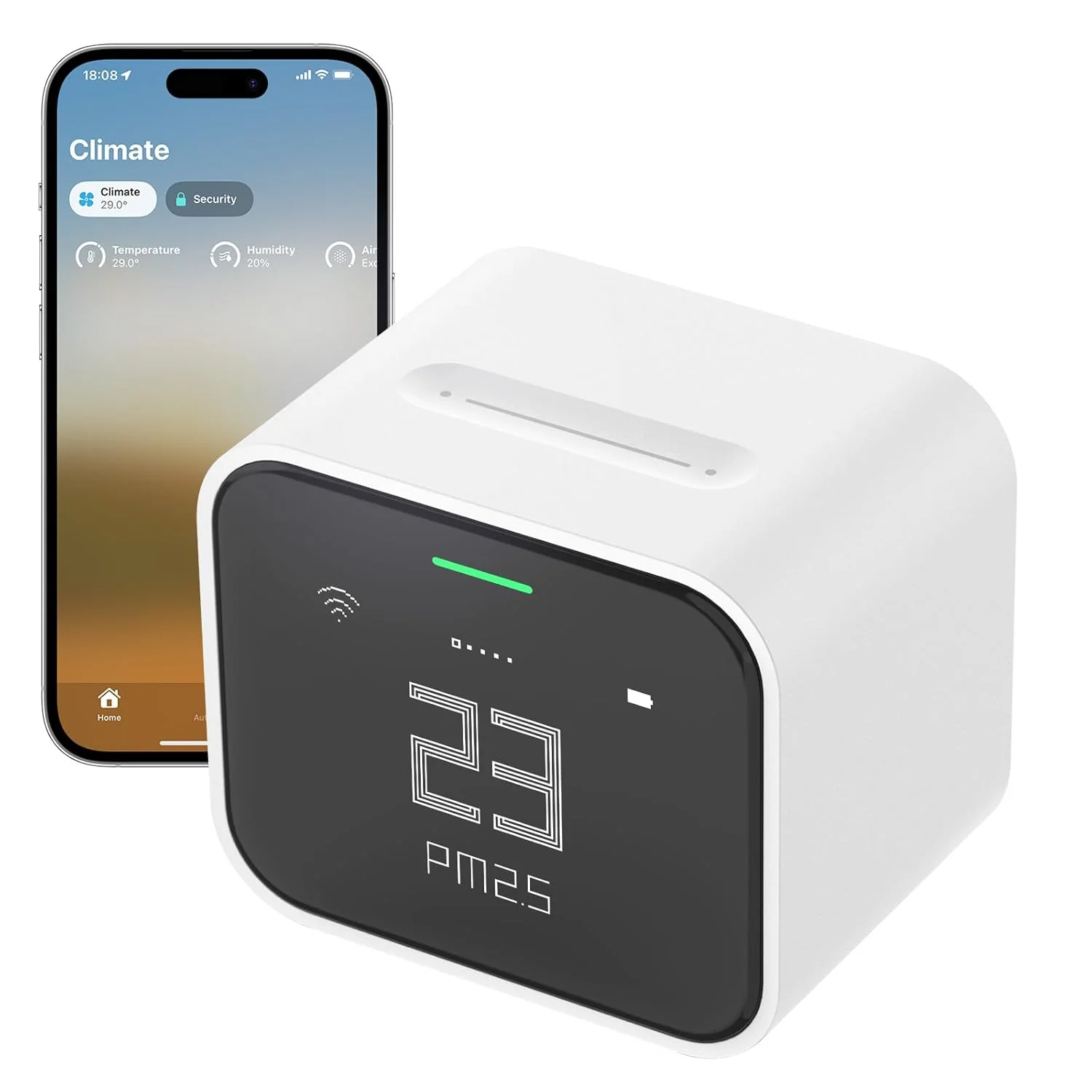
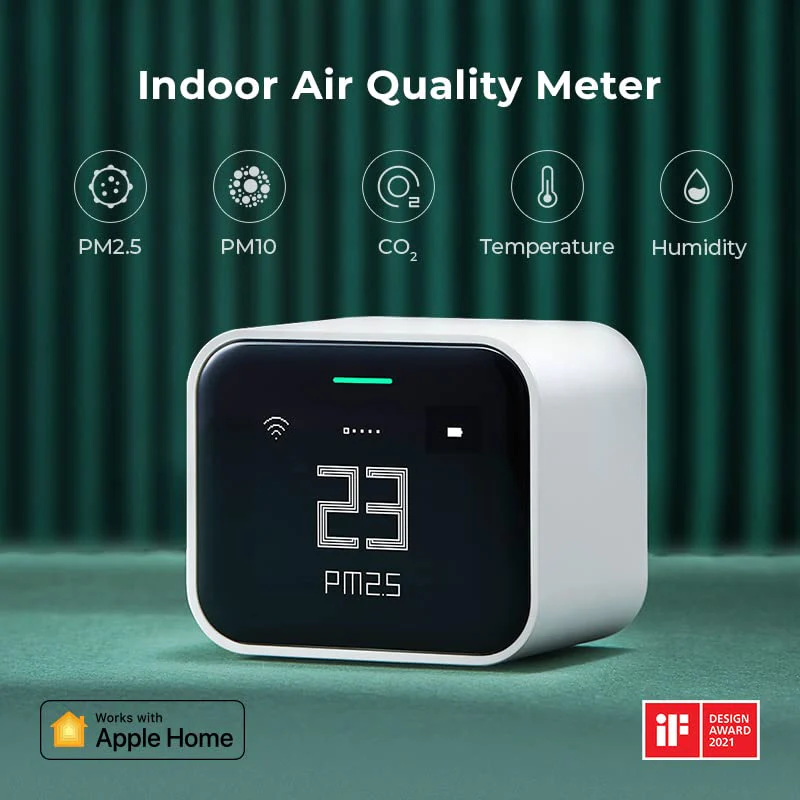
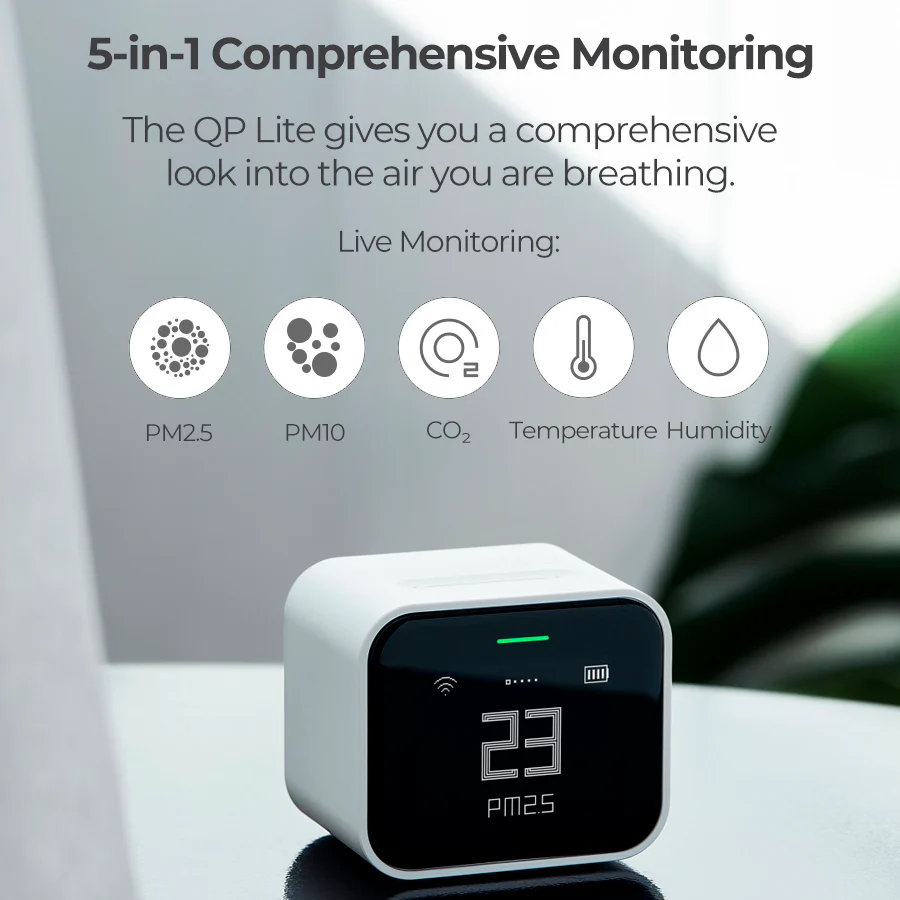
The Qingping Air Monitor Lite (sold as the QP Lite in the Smart Air range) is a compact desktop-or-portable monitor measuring PM2.5, PM10, CO₂, temperature, and humidity — with native Apple HomeKit, Qingping+, and Xiaomi Mi Home support. Designed for buyers who want clear, accurate readings of the metrics that matter most without the full 7-in-1 sensor suite.
What it measures
- PM2.5 — fine particulate matter (smoke, dust, pollen fragments, traffic pollution). Measured 0–500 µg/m³ via laser-scattering sensor.
- PM10 — coarse particulate matter (larger dust, pollen, mould spores). Same sensor as PM2.5.
- CO₂ — carbon dioxide concentration. Measured 400–9,999 ppm via NDIR sensor (the industry-standard high-accuracy CO₂ measurement method).
- Temperature — range 0–50°C.
- Humidity — range 0–95% RH (non-condensing).
Note: the Lite does not measure TVOC (volatile organic compounds) or ambient noise. If those metrics matter to you, see the Qingping Air Monitor Gen 2 (QP Pro 2) — same brand, larger 7-in-1 sensor suite at a higher price.
Why HomeKit support matters
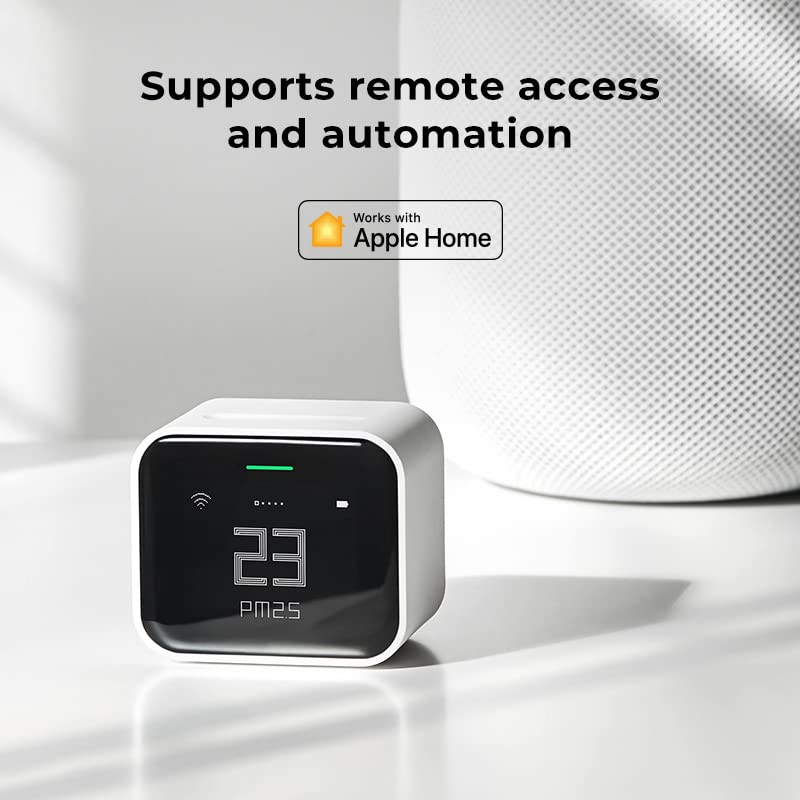
The Lite is the only Qingping air monitor with native Apple HomeKit support — Smart Air's own Pro 2 listing confirms the Pro 2 supports only the Qingping+ app, not HomeKit. If you're in the Apple ecosystem, native HomeKit support means:
- Air-quality data appears in the iOS Home app alongside your other smart-home devices — no extra app needed for at-a-glance checks
- Automations — trigger your HomeKit-compatible air purifier, fan, or HVAC when PM2.5 or CO₂ crosses a threshold
- Siri integration — ask Siri for current air quality readings hands-free
- Remote monitoring via your home hub (HomePod, Apple TV, or iPad)
Built for at-a-glance use
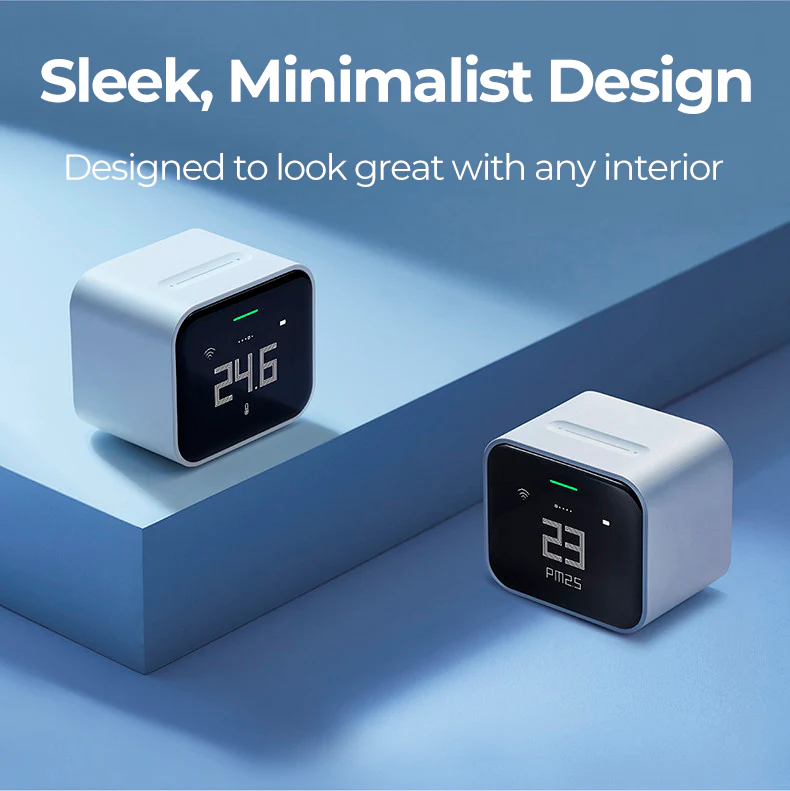
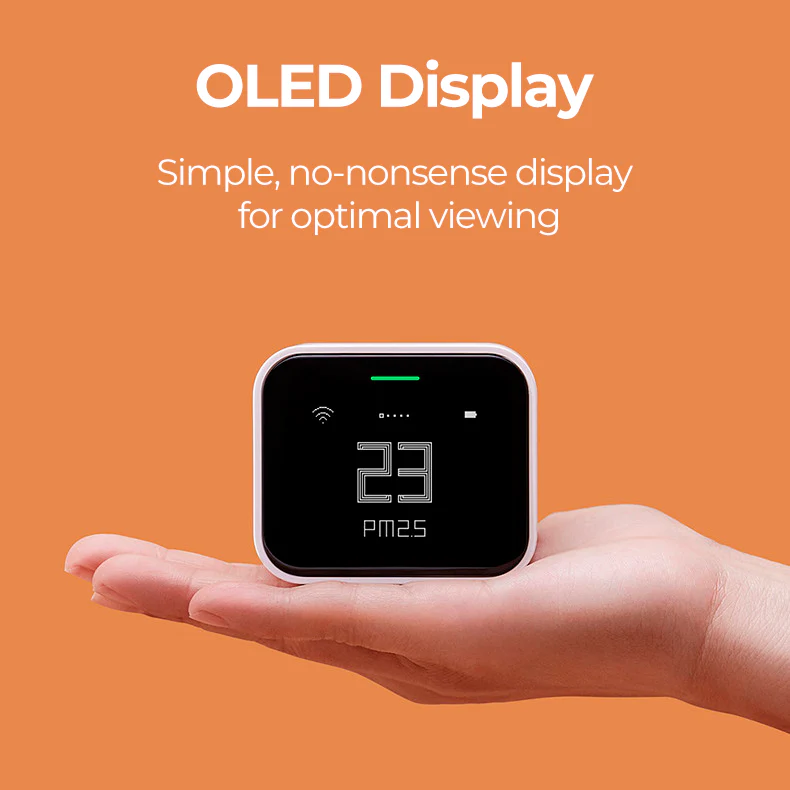
- OLED display with sharp text and high contrast — readable from across a room
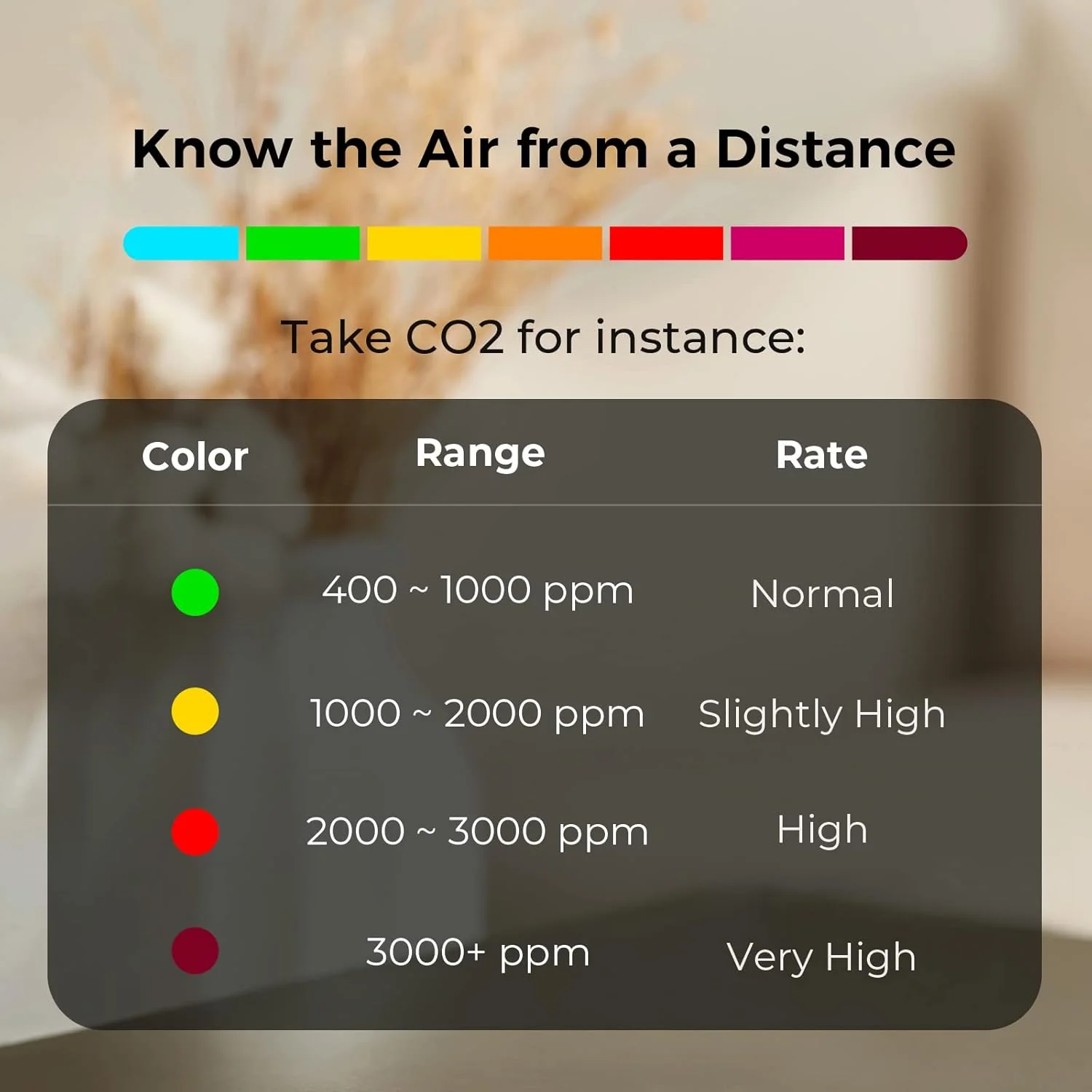
- Colour-coded LED strip — green / yellow / red traffic-light indicator showing overall air quality at a glance, even without reading the numbers
- Capacitive touch bar — tap or slide along the top edge to switch between metric pages
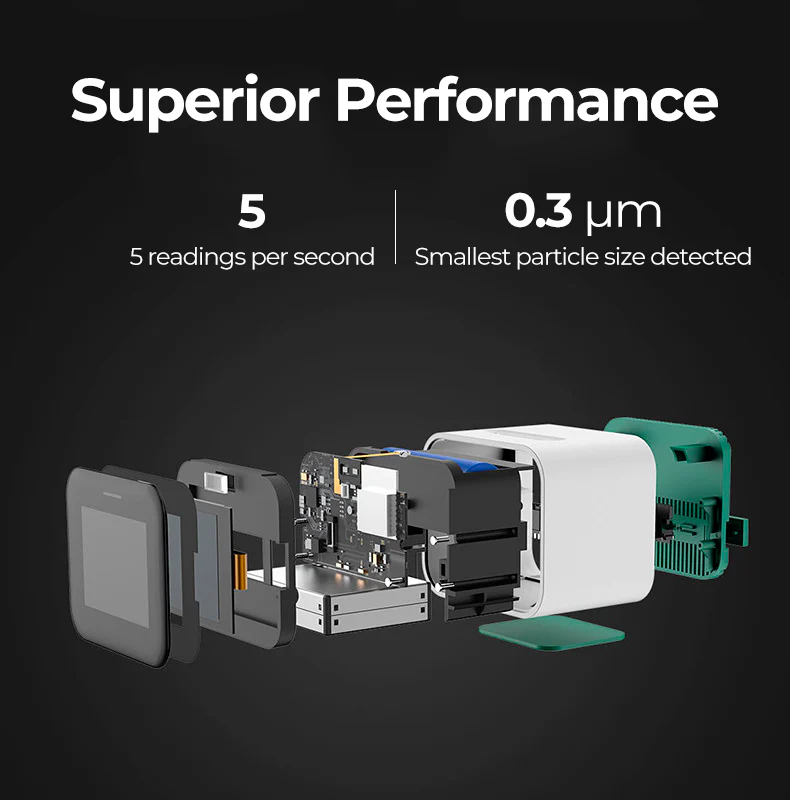
- Fast refresh — readings update 5 times per second; see CO₂ rise as the room fills with people
- Historical data — 24 hours of hourly data plus 7 days of daily highs/lows on-device; up to 30 days of full data via the Qingping+ app
Smart home and app connectivity
- Apple HomeKit — native integration via the iOS Home app
- Qingping+ app (iOS and Android) — primary control app with full historical data export and remote monitoring
- Xiaomi Mi Home / Xiaomi Home app — integrates with Mi-compatible air purifiers, fans, dehumidifiers, and humidifiers
- Wi-Fi 2.4 GHz + Bluetooth 5.0
- Firmware upgrades via Qingping+ app
Specifications
- Display: OLED, approximately 60 × 50 mm
- PM sensor: laser-scattering, 0–500 µg/m³
- CO₂ sensor: NDIR, 400–9,999 ppm
- Temperature range: 0–50°C
- Humidity range: 0–95% RH (non-condensing)
- Connectivity: Wi-Fi 2.4 GHz, Bluetooth 5.0
- Supported platforms: Apple HomeKit, Qingping+ app, Xiaomi Mi Home
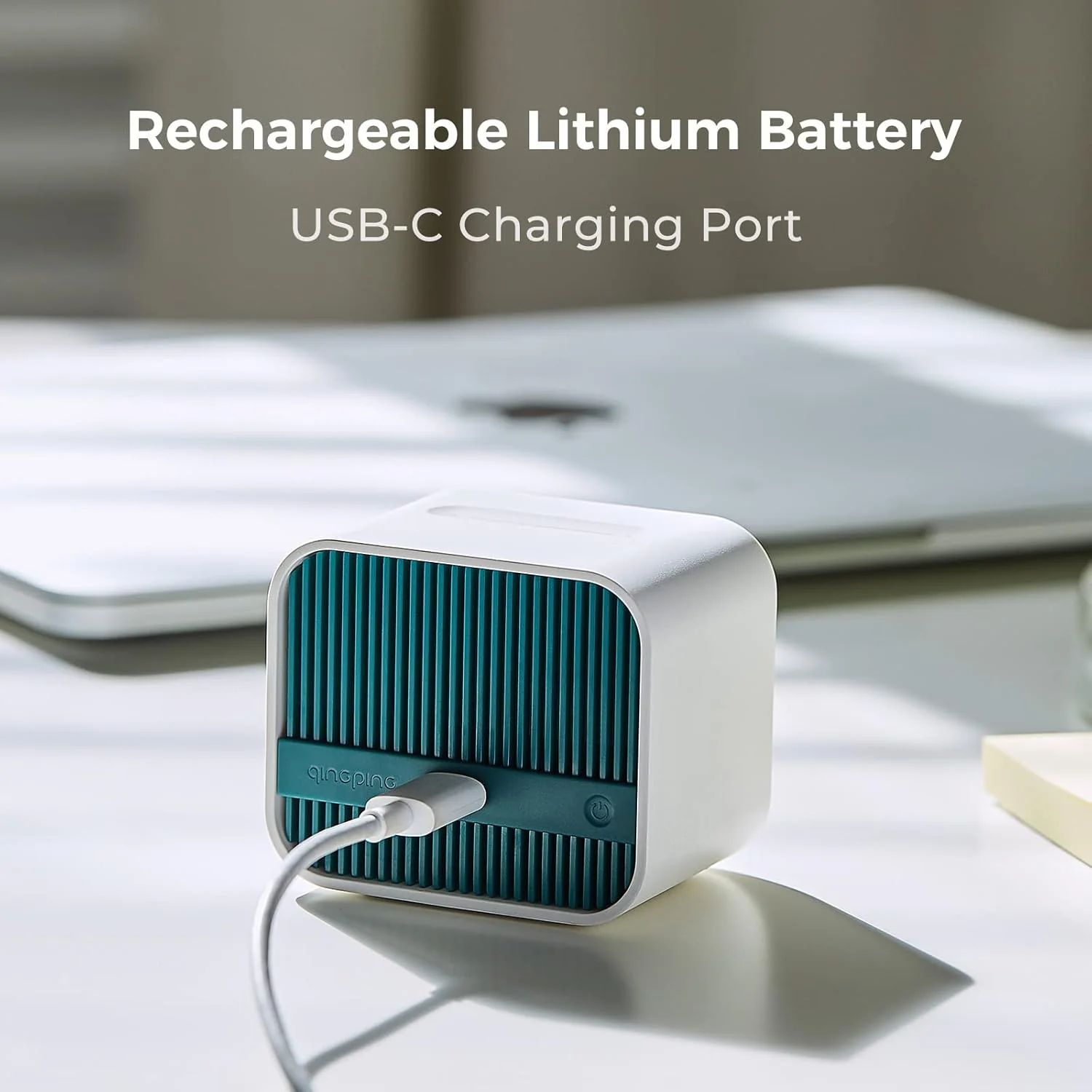
- Power: USB-C (5V / 1A adapter, sold separately)
- Battery: 1800 mAh / 3.7V built-in lithium-ion, approximately 6.5–7 hours runtime
- Dimensions: 63.6 × 46 × 54.6 mm
- Weight: 143 g
- Form factor: Desktop or portable (compact enough for travel)
- Warranty: 1-year limited (Qingping)
Independent accuracy testing
Smart Air placed both the Pro and Lite Qingping monitors alongside official government PM2.5 monitoring stations in Beijing, plus an IQAir AirVisual unit, over a 17-day measurement period. Both Qingping monitors had similar correlation with the government readings; the Lite was within ±9 µg/m³ of the official monitor on average — better than the IQAir AirVisual unit Smart Air had previously rated as their top-tested air quality monitor. South Coast AQMD (California's air quality regulator) has also tested the Qingping monitors and found them more accurate than commercial reference monitors costing 50× more.
This is the testing referenced in the line "accuracy is confirmed by Smart Air's third-party testing process" on Smart Air's own product page.
Why a standalone monitor instead of relying on your air purifier's built-in sensor?
Air purifiers with built-in air-quality sensors typically place those sensors in the air intake — where they're measuring the dirtiest air in the room (the air heading into the filter), not the air you're breathing. A standalone monitor placed at desk or bedside height gives a more accurate reading of your actual breathing zone. Pairing the two is the standard approach: the monitor tells you what your air is doing; the purifier responds.
Pair with HEPA filtration
Measuring is the first step; reducing pollutant levels is the second. If your monitor shows elevated PM2.5, an HEPA air purifier sized to the room is the standard response. If CO₂ stays consistently high, the answer is ventilation — opening a window or improving HVAC airflow.
Compatible Smart Air purifier options:
- SmartAir Sqair — bedroom-scale, ozone-free, optional carbon filter
- SmartAir SA-600 — living-room scale, dual H13 HEPA, ozone-free
- SmartAir Blast Mini Mk II — mid-size commercial, H13, all-metal
- SmartAir Blast Mk II — full commercial, H13, large spaces
What it doesn't do
This is an air quality monitor, not a medical device. The readings are designed to inform decisions about ventilation and filtration. If you're managing a specific health condition that's sensitive to indoor air quality, please discuss your environment with your GP or specialist — they're best placed to advise.
FAQs
Lite vs Pro 2 — which should I buy?
Choose the Lite if: you want native Apple HomeKit support (the Pro 2 doesn't have this); you primarily care about PM2.5, CO₂, temperature, and humidity; or budget is a factor ($149 vs $235). Choose the Pro 2 if: you also need TVOC measurement (formaldehyde, VOCs from cleaning products, off-gassing); you want noise measurement; you want the larger 4-inch touchscreen; or you need the higher-end sensor suite. Both have third-party-verified PM accuracy.
Does it work without Wi-Fi or HomeKit?
Yes — the device displays all 5 readings on its built-in OLED without internet. Wi-Fi and HomeKit unlock the Qingping+ app's historical data, automations, remote monitoring, and smart home integration.
How accurate is it?
The Lite uses a laser-scattering PM sensor and an NDIR CO₂ sensor — both are appropriate sensor types for these measurements (NDIR for CO₂ is particularly important; cheaper monitors fake CO₂ via VOC estimation). Smart Air's third-party testing showed the Lite's PM2.5 readings tracked closely with government reference monitors over a 17-day comparison.
How long does the battery last?
Approximately 6.5–7 hours under typical use (Smart Air states ~7 hours; their FAQ notes 6.5 hours fully charged to auto-shutdown). The unit is designed for continuous USB-C powered desktop use; the battery is for short relocation between rooms or brief portable use.
Where should I place it?
At breathing height (1–1.5 m) in a high-occupancy area — bedside table, desk, kitchen counter, living room. Avoid placing near windows, near heat sources or cooking surfaces, or in airflow paths.
Does it measure radon, ozone, or NO₂?
No — those require specialised single-purpose monitors. The Lite covers PM2.5, PM10, CO₂, temperature, and humidity; for VOCs add the Pro 2.
Is the PM sensor replaceable?
No — unlike the Pro 2 which has a magazine-style replaceable PM sensor, the Lite's sensor is integrated. Most users find this isn't a problem because laser-scattering sensors typically remain accurate for several years of typical home use.
Care notes
Keep on a stable surface or carry portably. Don't block the air vent on the back. Avoid extended use in environments above 90% humidity. Wipe with a dry cloth — no liquid cleaning. Battery should be charged at ambient temperatures below 40°C.
More Images

Air Quality Monitor | Qingping Lite Air | App connection
5-in-1 indoor air quality monitor with Apple HomeKit support
The Qingping Air Monitor Lite (sold as the QP Lite in the Smart Air range) is a compact desktop-or-portable monitor measuring PM2.5, PM10, CO₂, temperature, and humidity — with native Apple HomeKit, Qingping+, and Xiaomi Mi Home support. Designed for buyers who want clear, accurate readings of the metrics that matter most without the full 7-in-1 sensor suite.
What it measures
- PM2.5 — fine particulate matter (smoke, dust, pollen fragments, traffic pollution). Measured 0–500 µg/m³ via laser-scattering sensor.
- PM10 — coarse particulate matter (larger dust, pollen, mould spores). Same sensor as PM2.5.
- CO₂ — carbon dioxide concentration. Measured 400–9,999 ppm via NDIR sensor (the industry-standard high-accuracy CO₂ measurement method).
- Temperature — range 0–50°C.
- Humidity — range 0–95% RH (non-condensing).
Note: the Lite does not measure TVOC (volatile organic compounds) or ambient noise. If those metrics matter to you, see the Qingping Air Monitor Gen 2 (QP Pro 2) — same brand, larger 7-in-1 sensor suite at a higher price.
Why HomeKit support matters
The Lite is the only Qingping air monitor with native Apple HomeKit support — Smart Air's own Pro 2 listing confirms the Pro 2 supports only the Qingping+ app, not HomeKit. If you're in the Apple ecosystem, native HomeKit support means:
- Air-quality data appears in the iOS Home app alongside your other smart-home devices — no extra app needed for at-a-glance checks
- Automations — trigger your HomeKit-compatible air purifier, fan, or HVAC when PM2.5 or CO₂ crosses a threshold
- Siri integration — ask Siri for current air quality readings hands-free
- Remote monitoring via your home hub (HomePod, Apple TV, or iPad)
Built for at-a-glance use
- OLED display with sharp text and high contrast — readable from across a room
- Colour-coded LED strip — green / yellow / red traffic-light indicator showing overall air quality at a glance, even without reading the numbers
- Capacitive touch bar — tap or slide along the top edge to switch between metric pages
- Fast refresh — readings update 5 times per second; see CO₂ rise as the room fills with people
- Historical data — 24 hours of hourly data plus 7 days of daily highs/lows on-device; up to 30 days of full data via the Qingping+ app
Smart home and app connectivity
- Apple HomeKit — native integration via the iOS Home app
- Qingping+ app (iOS and Android) — primary control app with full historical data export and remote monitoring
- Xiaomi Mi Home / Xiaomi Home app — integrates with Mi-compatible air purifiers, fans, dehumidifiers, and humidifiers
- Wi-Fi 2.4 GHz + Bluetooth 5.0
- Firmware upgrades via Qingping+ app
Specifications
- Display: OLED, approximately 60 × 50 mm
- PM sensor: laser-scattering, 0–500 µg/m³
- CO₂ sensor: NDIR, 400–9,999 ppm
- Temperature range: 0–50°C
- Humidity range: 0–95% RH (non-condensing)
- Connectivity: Wi-Fi 2.4 GHz, Bluetooth 5.0
- Supported platforms: Apple HomeKit, Qingping+ app, Xiaomi Mi Home
- Power: USB-C (5V / 1A adapter, sold separately)
- Battery: 1800 mAh / 3.7V built-in lithium-ion, approximately 6.5–7 hours runtime
- Dimensions: 63.6 × 46 × 54.6 mm
- Weight: 143 g
- Form factor: Desktop or portable (compact enough for travel)
- Warranty: 1-year limited (Qingping)
Independent accuracy testing
Smart Air placed both the Pro and Lite Qingping monitors alongside official government PM2.5 monitoring stations in Beijing, plus an IQAir AirVisual unit, over a 17-day measurement period. Both Qingping monitors had similar correlation with the government readings; the Lite was within ±9 µg/m³ of the official monitor on average — better than the IQAir AirVisual unit Smart Air had previously rated as their top-tested air quality monitor. South Coast AQMD (California's air quality regulator) has also tested the Qingping monitors and found them more accurate than commercial reference monitors costing 50× more.
This is the testing referenced in the line "accuracy is confirmed by Smart Air's third-party testing process" on Smart Air's own product page.
Why a standalone monitor instead of relying on your air purifier's built-in sensor?
Air purifiers with built-in air-quality sensors typically place those sensors in the air intake — where they're measuring the dirtiest air in the room (the air heading into the filter), not the air you're breathing. A standalone monitor placed at desk or bedside height gives a more accurate reading of your actual breathing zone. Pairing the two is the standard approach: the monitor tells you what your air is doing; the purifier responds.
Pair with HEPA filtration
Measuring is the first step; reducing pollutant levels is the second. If your monitor shows elevated PM2.5, an HEPA air purifier sized to the room is the standard response. If CO₂ stays consistently high, the answer is ventilation — opening a window or improving HVAC airflow.
Compatible Smart Air purifier options:
- SmartAir Sqair — bedroom-scale, ozone-free, optional carbon filter
- SmartAir SA-600 — living-room scale, dual H13 HEPA, ozone-free
- SmartAir Blast Mini Mk II — mid-size commercial, H13, all-metal
- SmartAir Blast Mk II — full commercial, H13, large spaces
What it doesn't do
This is an air quality monitor, not a medical device. The readings are designed to inform decisions about ventilation and filtration. If you're managing a specific health condition that's sensitive to indoor air quality, please discuss your environment with your GP or specialist — they're best placed to advise.
FAQs
Lite vs Pro 2 — which should I buy?
Choose the Lite if: you want native Apple HomeKit support (the Pro 2 doesn't have this); you primarily care about PM2.5, CO₂, temperature, and humidity; or budget is a factor ($149 vs $235). Choose the Pro 2 if: you also need TVOC measurement (formaldehyde, VOCs from cleaning products, off-gassing); you want noise measurement; you want the larger 4-inch touchscreen; or you need the higher-end sensor suite. Both have third-party-verified PM accuracy.
Does it work without Wi-Fi or HomeKit?
Yes — the device displays all 5 readings on its built-in OLED without internet. Wi-Fi and HomeKit unlock the Qingping+ app's historical data, automations, remote monitoring, and smart home integration.
How accurate is it?
The Lite uses a laser-scattering PM sensor and an NDIR CO₂ sensor — both are appropriate sensor types for these measurements (NDIR for CO₂ is particularly important; cheaper monitors fake CO₂ via VOC estimation). Smart Air's third-party testing showed the Lite's PM2.5 readings tracked closely with government reference monitors over a 17-day comparison.
How long does the battery last?
Approximately 6.5–7 hours under typical use (Smart Air states ~7 hours; their FAQ notes 6.5 hours fully charged to auto-shutdown). The unit is designed for continuous USB-C powered desktop use; the battery is for short relocation between rooms or brief portable use.
Where should I place it?
At breathing height (1–1.5 m) in a high-occupancy area — bedside table, desk, kitchen counter, living room. Avoid placing near windows, near heat sources or cooking surfaces, or in airflow paths.
Does it measure radon, ozone, or NO₂?
No — those require specialised single-purpose monitors. The Lite covers PM2.5, PM10, CO₂, temperature, and humidity; for VOCs add the Pro 2.
Is the PM sensor replaceable?
No — unlike the Pro 2 which has a magazine-style replaceable PM sensor, the Lite's sensor is integrated. Most users find this isn't a problem because laser-scattering sensors typically remain accurate for several years of typical home use.
Care notes
Keep on a stable surface or carry portably. Don't block the air vent on the back. Avoid extended use in environments above 90% humidity. Wipe with a dry cloth — no liquid cleaning. Battery should be charged at ambient temperatures below 40°C.
Product Information
Product Information
Shipping & Returns
Shipping & Returns
Description
5-in-1 indoor air quality monitor with Apple HomeKit support
The Qingping Air Monitor Lite (sold as the QP Lite in the Smart Air range) is a compact desktop-or-portable monitor measuring PM2.5, PM10, CO₂, temperature, and humidity — with native Apple HomeKit, Qingping+, and Xiaomi Mi Home support. Designed for buyers who want clear, accurate readings of the metrics that matter most without the full 7-in-1 sensor suite.
What it measures
- PM2.5 — fine particulate matter (smoke, dust, pollen fragments, traffic pollution). Measured 0–500 µg/m³ via laser-scattering sensor.
- PM10 — coarse particulate matter (larger dust, pollen, mould spores). Same sensor as PM2.5.
- CO₂ — carbon dioxide concentration. Measured 400–9,999 ppm via NDIR sensor (the industry-standard high-accuracy CO₂ measurement method).
- Temperature — range 0–50°C.
- Humidity — range 0–95% RH (non-condensing).
Note: the Lite does not measure TVOC (volatile organic compounds) or ambient noise. If those metrics matter to you, see the Qingping Air Monitor Gen 2 (QP Pro 2) — same brand, larger 7-in-1 sensor suite at a higher price.
Why HomeKit support matters
The Lite is the only Qingping air monitor with native Apple HomeKit support — Smart Air's own Pro 2 listing confirms the Pro 2 supports only the Qingping+ app, not HomeKit. If you're in the Apple ecosystem, native HomeKit support means:
- Air-quality data appears in the iOS Home app alongside your other smart-home devices — no extra app needed for at-a-glance checks
- Automations — trigger your HomeKit-compatible air purifier, fan, or HVAC when PM2.5 or CO₂ crosses a threshold
- Siri integration — ask Siri for current air quality readings hands-free
- Remote monitoring via your home hub (HomePod, Apple TV, or iPad)
Built for at-a-glance use
- OLED display with sharp text and high contrast — readable from across a room
- Colour-coded LED strip — green / yellow / red traffic-light indicator showing overall air quality at a glance, even without reading the numbers
- Capacitive touch bar — tap or slide along the top edge to switch between metric pages
- Fast refresh — readings update 5 times per second; see CO₂ rise as the room fills with people
- Historical data — 24 hours of hourly data plus 7 days of daily highs/lows on-device; up to 30 days of full data via the Qingping+ app
Smart home and app connectivity
- Apple HomeKit — native integration via the iOS Home app
- Qingping+ app (iOS and Android) — primary control app with full historical data export and remote monitoring
- Xiaomi Mi Home / Xiaomi Home app — integrates with Mi-compatible air purifiers, fans, dehumidifiers, and humidifiers
- Wi-Fi 2.4 GHz + Bluetooth 5.0
- Firmware upgrades via Qingping+ app
Specifications
- Display: OLED, approximately 60 × 50 mm
- PM sensor: laser-scattering, 0–500 µg/m³
- CO₂ sensor: NDIR, 400–9,999 ppm
- Temperature range: 0–50°C
- Humidity range: 0–95% RH (non-condensing)
- Connectivity: Wi-Fi 2.4 GHz, Bluetooth 5.0
- Supported platforms: Apple HomeKit, Qingping+ app, Xiaomi Mi Home
- Power: USB-C (5V / 1A adapter, sold separately)
- Battery: 1800 mAh / 3.7V built-in lithium-ion, approximately 6.5–7 hours runtime
- Dimensions: 63.6 × 46 × 54.6 mm
- Weight: 143 g
- Form factor: Desktop or portable (compact enough for travel)
- Warranty: 1-year limited (Qingping)
Independent accuracy testing
Smart Air placed both the Pro and Lite Qingping monitors alongside official government PM2.5 monitoring stations in Beijing, plus an IQAir AirVisual unit, over a 17-day measurement period. Both Qingping monitors had similar correlation with the government readings; the Lite was within ±9 µg/m³ of the official monitor on average — better than the IQAir AirVisual unit Smart Air had previously rated as their top-tested air quality monitor. South Coast AQMD (California's air quality regulator) has also tested the Qingping monitors and found them more accurate than commercial reference monitors costing 50× more.
This is the testing referenced in the line "accuracy is confirmed by Smart Air's third-party testing process" on Smart Air's own product page.
Why a standalone monitor instead of relying on your air purifier's built-in sensor?
Air purifiers with built-in air-quality sensors typically place those sensors in the air intake — where they're measuring the dirtiest air in the room (the air heading into the filter), not the air you're breathing. A standalone monitor placed at desk or bedside height gives a more accurate reading of your actual breathing zone. Pairing the two is the standard approach: the monitor tells you what your air is doing; the purifier responds.
Pair with HEPA filtration
Measuring is the first step; reducing pollutant levels is the second. If your monitor shows elevated PM2.5, an HEPA air purifier sized to the room is the standard response. If CO₂ stays consistently high, the answer is ventilation — opening a window or improving HVAC airflow.
Compatible Smart Air purifier options:
- SmartAir Sqair — bedroom-scale, ozone-free, optional carbon filter
- SmartAir SA-600 — living-room scale, dual H13 HEPA, ozone-free
- SmartAir Blast Mini Mk II — mid-size commercial, H13, all-metal
- SmartAir Blast Mk II — full commercial, H13, large spaces
What it doesn't do
This is an air quality monitor, not a medical device. The readings are designed to inform decisions about ventilation and filtration. If you're managing a specific health condition that's sensitive to indoor air quality, please discuss your environment with your GP or specialist — they're best placed to advise.
FAQs
Lite vs Pro 2 — which should I buy?
Choose the Lite if: you want native Apple HomeKit support (the Pro 2 doesn't have this); you primarily care about PM2.5, CO₂, temperature, and humidity; or budget is a factor ($149 vs $235). Choose the Pro 2 if: you also need TVOC measurement (formaldehyde, VOCs from cleaning products, off-gassing); you want noise measurement; you want the larger 4-inch touchscreen; or you need the higher-end sensor suite. Both have third-party-verified PM accuracy.
Does it work without Wi-Fi or HomeKit?
Yes — the device displays all 5 readings on its built-in OLED without internet. Wi-Fi and HomeKit unlock the Qingping+ app's historical data, automations, remote monitoring, and smart home integration.
How accurate is it?
The Lite uses a laser-scattering PM sensor and an NDIR CO₂ sensor — both are appropriate sensor types for these measurements (NDIR for CO₂ is particularly important; cheaper monitors fake CO₂ via VOC estimation). Smart Air's third-party testing showed the Lite's PM2.5 readings tracked closely with government reference monitors over a 17-day comparison.
How long does the battery last?
Approximately 6.5–7 hours under typical use (Smart Air states ~7 hours; their FAQ notes 6.5 hours fully charged to auto-shutdown). The unit is designed for continuous USB-C powered desktop use; the battery is for short relocation between rooms or brief portable use.
Where should I place it?
At breathing height (1–1.5 m) in a high-occupancy area — bedside table, desk, kitchen counter, living room. Avoid placing near windows, near heat sources or cooking surfaces, or in airflow paths.
Does it measure radon, ozone, or NO₂?
No — those require specialised single-purpose monitors. The Lite covers PM2.5, PM10, CO₂, temperature, and humidity; for VOCs add the Pro 2.
Is the PM sensor replaceable?
No — unlike the Pro 2 which has a magazine-style replaceable PM sensor, the Lite's sensor is integrated. Most users find this isn't a problem because laser-scattering sensors typically remain accurate for several years of typical home use.
Care notes
Keep on a stable surface or carry portably. Don't block the air vent on the back. Avoid extended use in environments above 90% humidity. Wipe with a dry cloth — no liquid cleaning. Battery should be charged at ambient temperatures below 40°C.